
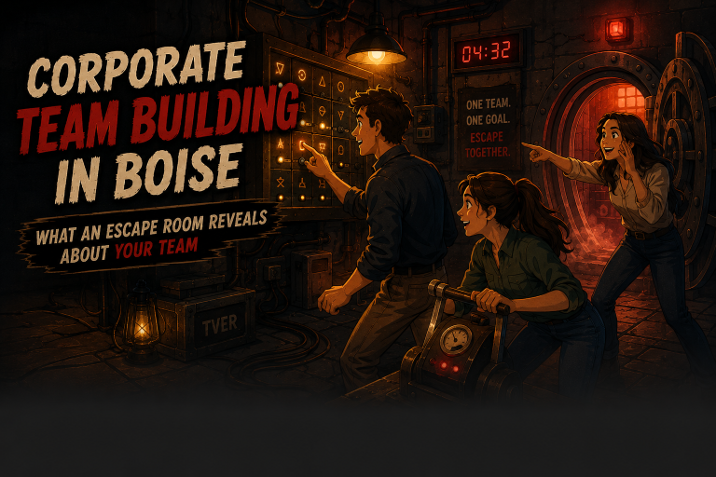
Escape rooms give workplace teams a real, time-limited problem that requires communication, delegation and shared accountability. TVER can run up to 36 players per hour across multiple private rooms, offers group pricing and has an optional event room for meetings, food and post-game discussion.
Most employees can detect forced fun before the calendar invitation finishes loading.
A useful team-building activity needs to be enjoyable on its own, but it should also reveal something real about how the group works. Escape rooms do that naturally. There is a goal, incomplete information, a deadline and no single person who can see everything at once. In other words, a project—just with better scenery and fewer spreadsheets.
Why Escape Rooms Create Real Teamwork
The team cannot succeed by standing in the same room and calling that collaboration. Players must share discoveries, divide tasks, connect information and decide when to abandon an unproductive idea. Those are genuine group behaviors, not a lecture about group behaviors.
Research has even used escape rooms as a way to study real-time communication and collaborative problem solving. That makes sense to anyone who has watched a team for five minutes: the room quickly exposes who shares information, who quietly solves, who organizes and who becomes emotionally attached to the wrong theory.
What You Can Observe During the Game
- Communication: Does information move across the whole team or remain in small clusters?
- Delegation: Do people divide tasks based on strengths, or does everyone crowd the same problem?
- Leadership: Does someone create clarity without taking control of every decision?
- Psychological safety: Are quieter people comfortable presenting an idea?
- Adaptability: Can the team abandon a theory when the evidence changes?
- Time management: Does anyone monitor the clock and ask for help before the final minute?
- Shared accountability: Does the group own mistakes, or immediately establish a committee to blame accounting?
TVER Corporate Group Capacity
Treasure Valley Escape Rooms can host up to 36 players per hour across four private rooms . Larger groups can be divided into multiple sessions, with the event room used as a meeting, food or waiting area between games.
16–22 Players
Split across multiple rooms and compare completion times.
23–36 Players
Run a full hourly rotation across all four private rooms.
37+ Players
Use multiple game sessions with an event-room rotation.
Rates and policies can change. Confirm the live quote and room availability with TVER before finalizing the event.
A Simple Team-Building Format
- Brief the teams. Explain that the goal is to notice how the group communicates, not merely to win.
- Run the private escape-room challenge. Assign teams based on departments, mixed roles or a deliberate cross-functional format.
- Debrief immediately. Ask what the team did well, where information stalled and when the group changed strategy.
- Connect the experience to work. Identify one behavior the team wants to repeat and one it wants to change.
- Finish with food, awards or a meeting. Use the event room if desired.
Useful Post-Game Debrief Questions
- What was the first moment the team became organized?
- Which information was found early but shared late?
- Who noticed a problem that others overlooked?
- When did the team ask for a hint, and what made that decision easy or difficult?
- Did people work in parallel or repeatedly gather around one task?
- What behavior from the game would improve an actual work project?
- What would the team do differently with another attempt?
Why Private Rooms Matter for Company Events
A corporate event is most useful when the people in the room are the people who work together. Public ticketing can add strangers, which changes leadership, communication and the quality of the debrief. Every TVER booking is private, so the exercise stays focused on your team.
Using the TVER Event Room
The separate event room seats up to 24 people and is available for $50 per hour, subject to availability. It includes tables, chairs, a refrigerator/freezer, microwave, Keurig, smart TV and basic serving tools. Companies can bring their own food or coordinate catering.
For larger groups, the room can serve as a check-in area, meeting space or rotation point while teams play in separate sessions.
Frequently Asked Questions
How many employees can TVER host?
TVER can run up to 36 players per hour across four rooms. Larger groups can be divided into multiple sessions.
Are the escape rooms private for corporate groups?
Yes. Every TVER booking is private, so only your employees are in the game.
Can teams compete against one another?
Yes. Groups can be split among rooms and compared by completion, time remaining, hints or a custom scoring format.
Is there a meeting or food space?
Yes. The separate event room seats up to 24 and can be rented for meetings, food, presentations or post-game debriefs.
Do employees need escape-room experience?
No. The game master explains everything before the session, and hints are available during play.
Ready for Your Mission?
Contact TVER with your date, headcount and event goals to build a private Boise team-building format for your company.
Plan Your Corporate Event
Comments(0)