
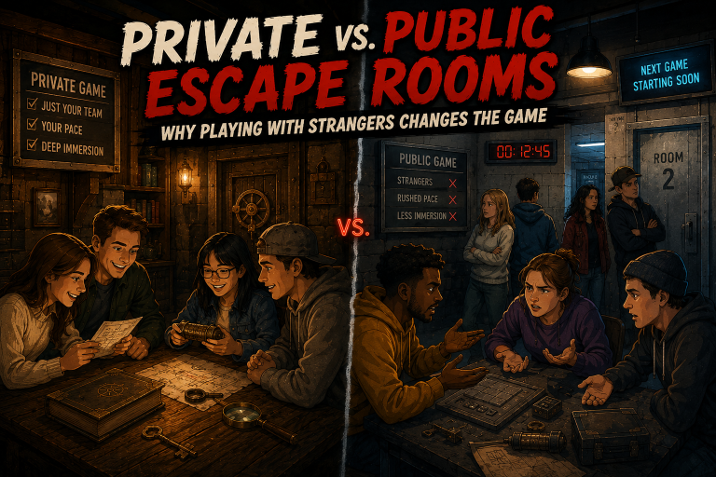
A private escape room is reserved only for your group. A public escape room may combine your booking with strangers who purchased the remaining seats. Private games provide more control, comfort and natural communication—especially for dates, families, birthdays and workplace teams.
Many first-time players assume every escape room is private. That is not always true.
Some businesses sell the room. Others sell seats. If a room holds eight and you book four seats, another group may book the remaining four. You then meet your new teammates at check-in and spend the next hour solving a fictional emergency together. Occasionally this creates new friendships. Occasionally it creates a very long hour.
What Is a Private Escape Room?
A private escape room is reserved exclusively for the people on your booking. Nobody else can purchase a seat in that game. At Treasure Valley Escape Rooms , every booking is private at no additional charge.
Book two players in Captured: Doctor Fear and the room is yours. Book six players in Gem Mine and the room is yours. Book a family group in Journey to Oz or gather a larger puzzle-focused team for Mad Hatter , and those rooms are yours as well. The only strangers involved are the fictional ones responsible for trapping you.
What Is a Public Escape Room?
A public escape room sells individual tickets up to the room's capacity. Unless you purchase every seat—or pay a private-room fee—the operator may combine groups.
This model can lower the entry price in some markets and helps solo players or couples join a larger team. It is not inherently dishonest as long as the policy is clear before checkout. The problem is that many customers do not realize what they booked until they arrive.
How Strangers Change Teamwork
Escape rooms reward fast communication. Established groups already know who talks loudly, who searches carefully, who organizes clues and who will try the same four-digit code upside down "just in case." Strangers have to learn those habits while the clock is running.
- People may hesitate to speak up or handle objects.
- One confident player can dominate the room.
- Different expectations about hints can cause friction.
- Parents have less control over how adults interact with their children.
- Coworkers cannot speak as naturally or evaluate their own team dynamics.
- Couples lose the shared, personal experience they intended to book.
Private Rooms Are Better for Dates
An escape room can be a great date because it creates conversation without requiring two people to manufacture small talk across a table. Add six strangers, however, and it becomes less of a date and more of a temporary project team.
A private room lets the couple set the pace, ask for hints when they want and enjoy the inevitable moment when one person notices the clue the other has been holding for five minutes.
Private Rooms Are Better for Families and Birthdays
Parents know their children's comfort level and can let them take the lead. In a public game, well-meaning adults may solve everything first, move too quickly or use language and humor the family did not sign up for.
Birthday groups also benefit from having the attention on the people actually celebrating. The room becomes part of the party rather than a shared attraction with unrelated guests. Families can also add TVER's private event room for food, cake, gifts and time together after the game.
Private Rooms Are Better for Corporate Team Building
The value of a team-building escape room is seeing how your actual team communicates. Adding strangers changes the experiment. Employees may defer to outsiders, hide their normal working style or avoid honest post-game discussion.
A private game keeps the challenge inside the group you brought, which makes the debrief more useful.
When a Public Game Can Make Sense
Public games can work for solo enthusiasts, travelers who enjoy meeting people or players who care more about trying a specific room than controlling the team. Some excellent escape rooms use public booking models.
The key is choosing knowingly. Before booking any escape room, look for language such as "private booking," "shared experience," "per seat" or "you may be paired with other guests." If the website is vague, call and ask.
Questions to Ask Before Booking
- Will anyone outside my group be added to the room?
- Is private booking included or an extra charge?
- What is the minimum number of paid players?
- Can we add players after booking?
- Does the listed price apply per person or to the entire room?
- Can we leave the room at any time?
Every TVER booking is private, pricing is listed per person and the entrance door remains unlocked. Additional policies and common questions are available on the Treasure Valley Escape Rooms FAQ .
Frequently Asked Questions
Are all Treasure Valley Escape Rooms games private?
Yes. Every booking is private at no extra charge.
Can two people book a private escape room?
Yes. Captured: Doctor Fear accepts two players. Other rooms have minimum group sizes of three or four.
Does private mean the door is locked?
No. Private means no other customers join your game. The entrance door remains unlocked so players can leave if needed.
Why do some escape rooms combine groups?
Public ticketing helps operators fill all available seats and lets smaller parties join a larger team. Policies vary, so check before booking.
Is a private room worth paying more for?
For dates, families, birthdays and team building, most groups prefer the comfort and control of a private room. TVER includes privacy in the standard price.
Ready for Your Mission?
Reserve a private Boise escape room at TVER—your group, your game and no unexpected teammates.
Check Availability and Book
Comments(0)