
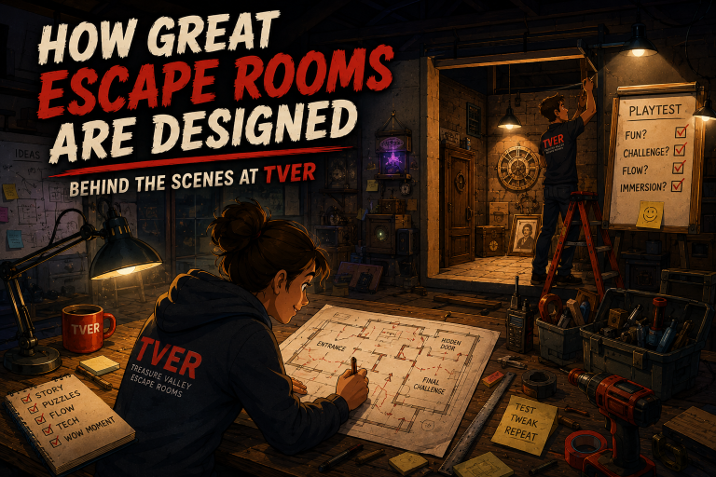
Great escape rooms are designed as complete experiences. Story, scenery, puzzle flow, technology, safety, reset speed and maintenance must work together. The strongest rooms are tested repeatedly with real players and improved after opening.
People often ask where we buy our escape rooms. The answer is that we do not.
Treasure Valley Escape Rooms designs and builds its games in-house. That means the story, layout, puzzles, props, electronics, lighting, audio and reveals are developed as one system.
It is a slower and considerably messier way to create a room, but it gives us control over the part that matters: whether the experience feels coherent from the first clue to the final moment.
It Starts With the Experience, Not a List of Puzzles
A weak design process begins with ten unrelated puzzles and asks how to decorate around them. A stronger process begins with a place, a mission and the emotional rhythm of the hour.
What should players feel when they enter? What changes halfway through? What is the final objective? How does the room reveal new information? Once those questions are answered, puzzles can be designed to belong in that world.
In Gem Mine , the pressure comes from being trapped underground with limited oxygen. In Journey to Oz , the interactions need to feel magical. In Mad Hatter , the puzzles should feel strange, playful and slightly unpredictable. In Captured: Doctor Fear , the environment creates suspense. The same puzzle copied into all four rooms would technically function, but it would not belong.
The Set Must Support the Story
Immersion is not a synonym for expensive. It means the environment is convincing and internally consistent. Materials, lighting, sound, wear, scale and prop placement should all reinforce the setting.
Players notice when a prop exists only because the designer needed somewhere to put a four-digit lock. They also notice when an interaction feels natural—turning the right object, restoring power, following a map or activating a mechanism that makes sense inside the story.
Puzzle Flow Is Architecture
The order in which players discover and solve things controls the pace of the entire hour. Too many open paths can feel chaotic. One narrow path can leave most of the group idle. The design needs enough structure to guide people and enough freedom to let the team explore.
We favor non-linear gameplay. Several puzzles can be active at once, then converge into larger milestones. This keeps more people involved and creates the satisfying moment when two groups realize the objects they found belong together.
Technology Should Feel Like Magic, Not a Computer Error
Modern escape rooms use sensors, controllers, magnets, lighting, sound, video and custom mechanisms. The best technology disappears into the experience. Players think, "We restored the machine," not, "An RFID reader detected the tag."
Every mechanism must be accessible for maintenance, manually controllable by the game master and tested repeatedly. A spectacular reveal that works 70 percent of the time is not spectacular. It is an appointment with a screwdriver.
Difficulty Comes From Connections, Not Obscurity
A designer can make any room difficult by hiding essential information or making clues vague. That is not good difficulty. Good difficulty comes from noticing, combining and reasoning.
- The team has enough information to solve the puzzle.
- The connection is challenging but explainable.
- The solution produces clear feedback.
- A hint can move the group forward without simply giving away the answer.
- The puzzle fits the story and physical environment.
Testing Is Where the Room Becomes Honest
Designers know every answer, which makes them nearly useless as final playtesters. We need people who have never seen the room to show us what is actually clear, what is accidentally misleading and where the game stalls.
We test with beginners, enthusiasts, different ages and different group sizes. We watch what teams touch first, what they ignore, how information travels and which instructions they misunderstand. Then we revise.
Sometimes the puzzle changes. Sometimes one light, label or sound fixes the entire problem.
A Room Is Not Finished on Opening Day
Opening day is the beginning of a much larger test. Hundreds of groups will interact with the room in ways no designer predicted. We track common sticking points, mechanical wear, reset mistakes and moments where the experience can be smoother.
We also repair constantly. Props loosen, finishes wear, sensors drift and players discover new interpretations of the phrase "do not force anything." Maintenance is not separate from design. A broken or shabby clue changes the game.
The Game Master Is Part of the Design
Hints need to match the room's logic and the team's progress. A generic hint such as "look closer" is rarely useful. The host should know what the group has found, what assumption is blocking it and how to provide the smallest nudge that restores momentum.
Reset design matters too. Every object needs a clear home, every mechanism needs a reliable reset state and every clue must be checked before the next group enters. The players should never feel the operational machinery behind the room.
Why We Build In-House
There are good purchased escape rooms and poor custom rooms. Building in-house does not automatically guarantee quality. What it guarantees is accountability. We cannot blame a distant designer when the flow is wrong. We own the story, the puzzle, the mechanism and the fix.
It also means our games are unique to Boise. We are not installing the same package found in multiple cities. The rooms reflect what we have learned from playing more than 200 games and from watching thousands of groups play ours.
What Players Should Notice in a Great Room
- The environment feels convincing before the first puzzle is solved.
- The team understands why it is doing each major task.
- Multiple players can contribute at the same time.
- Surprises follow logically from the story.
- Hints preserve the satisfaction of solving.
- The room is clean, maintained and reset correctly.
- The final sequence feels like a conclusion, not simply the last lock available.
Frequently Asked Questions
How long does it take to design an escape room?
It varies widely. Original rooms require story development, construction, puzzle prototyping, programming, scenic work, testing and revisions. A serious build often takes many months.
Do escape rooms buy pre-made games?
Some operators purchase complete game packages; others design in-house or use a mix. TVER designs and builds its rooms in Boise.
What makes an escape room puzzle fair?
Players must have enough information to reach the solution, and the connection should make sense when explained. Difficulty should come from reasoning, not missing or arbitrary clues.
Why are non-linear escape rooms good for groups?
They allow several puzzles to be active at once, keeping more players involved and encouraging information sharing.
How often are escape rooms changed?
Good operators continually repair and refine rooms. Major themes may remain for years, while clues, mechanisms, hints and scenic details improve over time.
Ready for Your Mission?
Experience an original escape room designed and built in Boise. Compare TVER's four private games and choose your next mission.
Compare Rooms and Book
Comments(0)